The postpartum recovery app that knows which week you’re in
Tell MatraBloom when you gave birth and how. It builds a short daily session for that week, holds back anything your body isn’t ready for, and asks how you’re doing every morning.
Vaginal, caesarean and VBAC
tracked apart
Pelvic floor from week two,
week four after a caesarean
General guidance, not medical advice — follow your provider’s clearance before starting to exercise. iOS coming soon, .
Your plan moves with you
BirthWeek 12
Week 3Initial Healing
This week we focus on:
Breathing
Gentle mobility
Pelvic floor
Strength
Light cardio unlocks at week 6.
Evidence-informedGuides cite NHS, ACOG and RCOG, and say when to call
Gated by birth typeEvery exercise has an earliest safe week, later after a caesarean
Built for tired morningsSessions run three to twenty minutes, and rest days count
Your data stays yoursNever sold, no public feed, deletable from inside the app
Two questions each morning. A session that fits the day.
Answer them the way you would tomorrow and watch today’s session resize. It is the rule the web plan uses, and the Android plan eases off the same way when you say a session was too much.
Example plan: week 3 after a caesarean, 15 minutes a day
Built around the week you’re in, not the week a programme assumes
Every part of MatraBloom starts from two facts: when you gave birth and how. The plan moves on those thresholds rather than on encouragement — pelvic floor at week two after a vaginal birth and week four after a caesarean, strength at three and six, core at eight and twelve.
Timeline
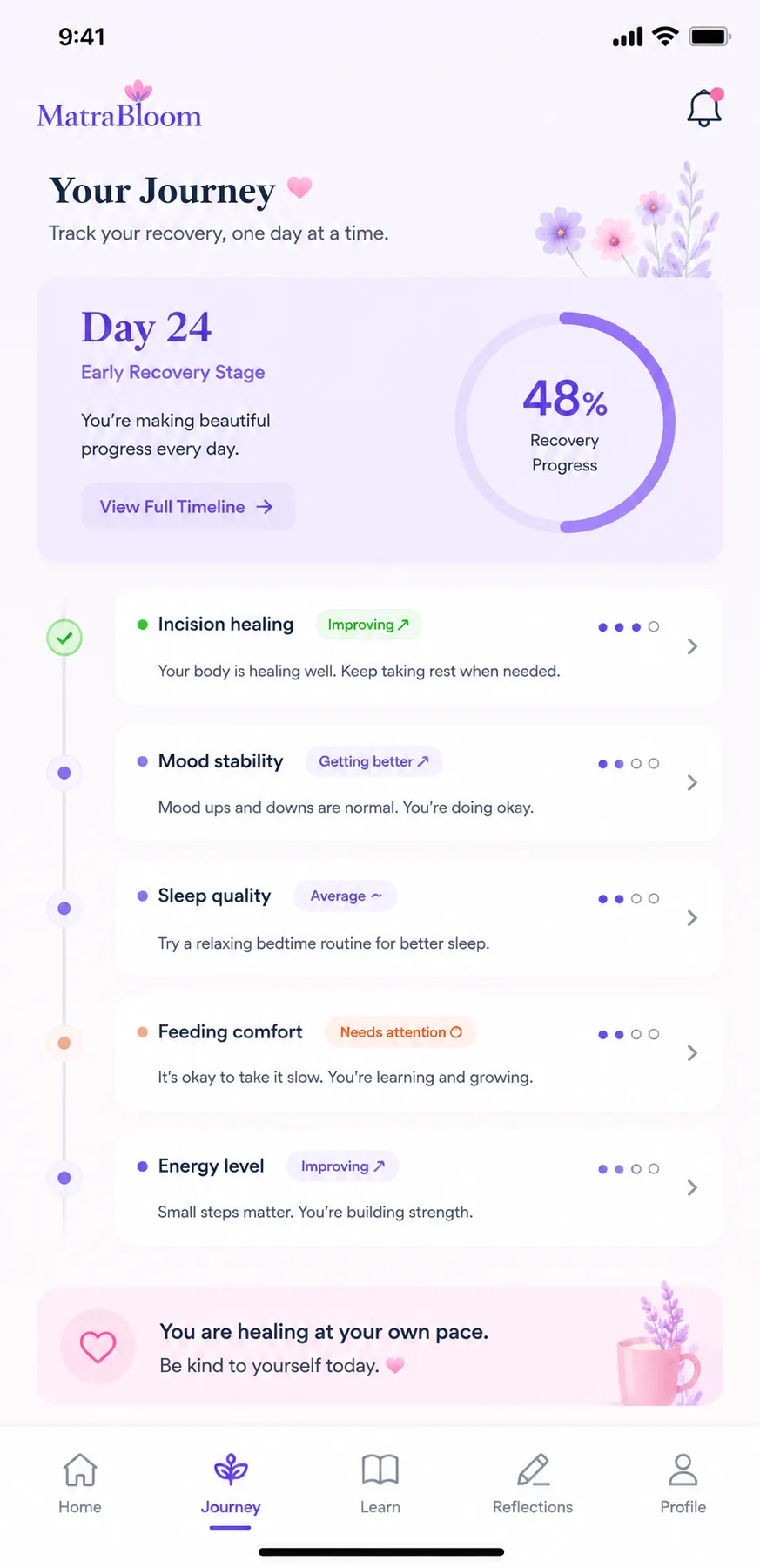
Your week, the phase it falls in, and which categories have opened so far
Recovery Timeline
Fifty-two weeks in six stages, from Early Recovery to Thriving. Each week says what tends to be happening, what to watch for and what movement is appropriate, with separate notes after a caesarean.
Recovery Milestones
Your first session, your fifth, your fiftieth; two, four and eight weeks at goal; and a check-in streak that grows from Seed to Full Bloom, with every stage you reach kept even if the streak breaks.
Personalized Guidance
Thirty-two exercises, each with its own earliest safe week and a later one after a caesarean or VBAC: pelvic tilts at two and four, bridges at three and six, core at eight and twelve, cardio held until week eight after a C-section.
Progress Tracking
Sessions completed against a weekly goal you set between two and five, a movement streak that allows two rest days, and sessions that lengthen after your fourth and your tenth.
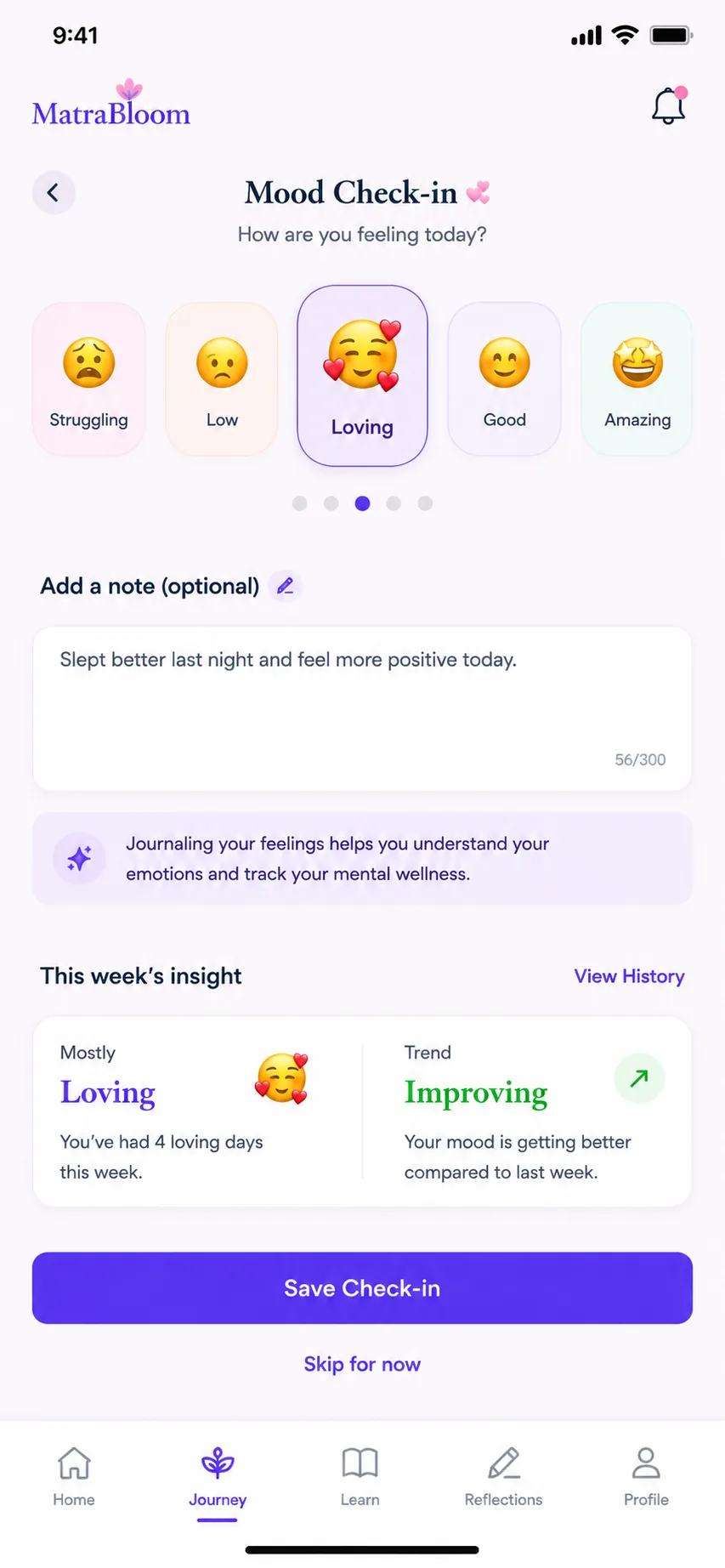
Mood Check-in
Mood and energy, asked once a morning and used to size that day’s session
Daily Check-ins
How you feel, how much energy you have, how confident you feel about your recovery, and a line of notes if you want one. One tap on busy mornings, once a day, and one missed day a week is forgiven.
Mood Tracking
Your check-ins plotted across your recovery weeks, with energy and confidence views and a one-line trend, so a run of low days is something you can see and name rather than something you have to remember.
Recovery Journal
A private entry whenever you want one, with a mood and six prompts for the days when a blank page is too much. Edit it, delete it, keep it; it never appears on a feed.
Learning Library
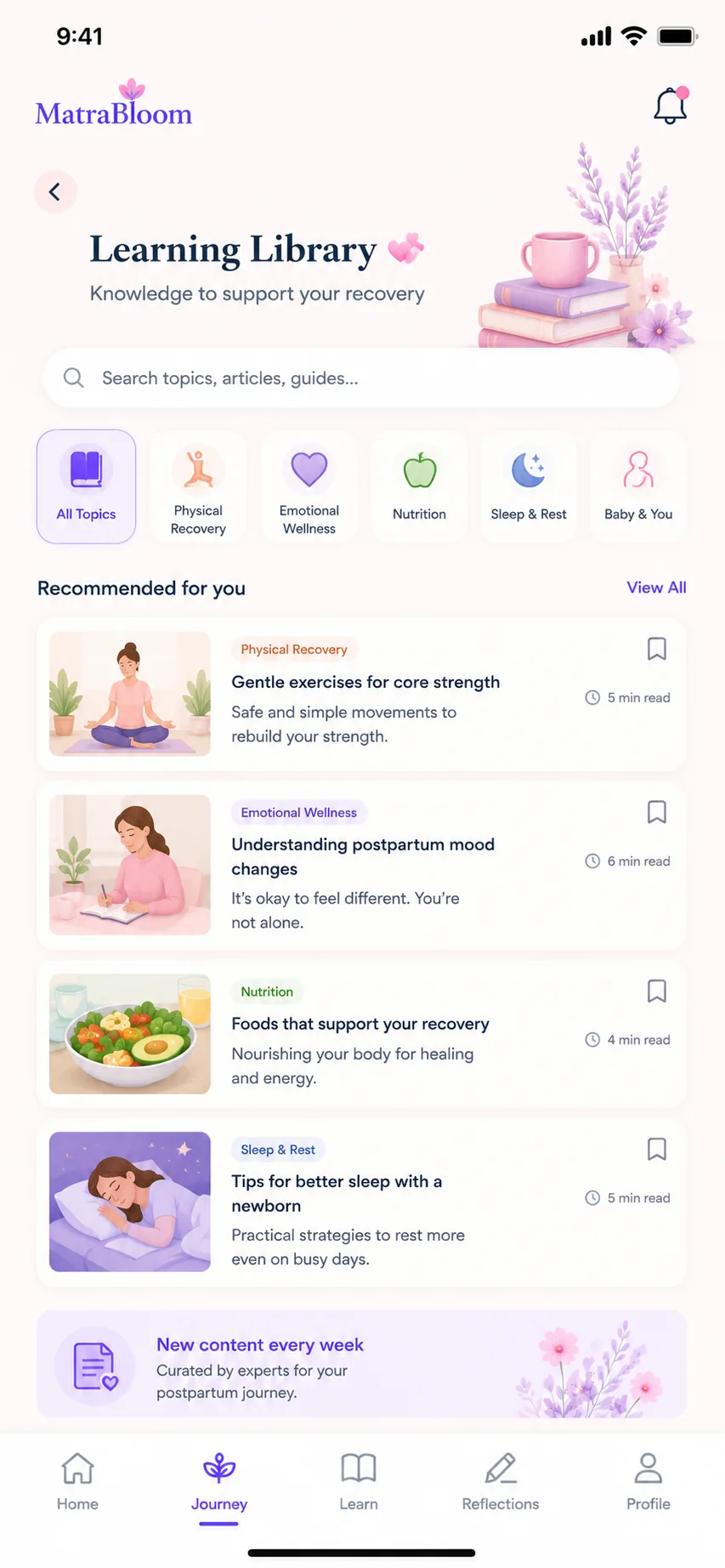
Postpartum guides, each one listing its sources at the end
Learning Library
Twenty-three short guides on recovery, mood, caesarean healing, food and exercise, each listing its sources and saying plainly when something warrants a call. Plus a seven-question mental-health check-in that points to real support.
Honest about recovery
Healing isn’t only physical, and it isn’t linear
Baby blues typically peak around days three to five and lift by the end of the second week. Low mood that is still there after that, or deepening, is worth naming to your midwife or doctor rather than waiting out.
For months the limiting factor is sleep rather than fitness. A good day is not a promise about tomorrow, and a hard week is not a step backwards.
Mood Tracking
Mon
Tue
Wed
Thu
Fri
Sat
Sun
How are you feeling?How much energy do you have?
MatraBloom asks how you feel and how much energy you have every morning, keeps the answers on your timeline so a low patch is something you can see, and includes a short mental-health check-in that points you to real support rather than pretending to be it.
Why we built this
Why the thresholds are in here
Most pregnancy apps stop at birth. The weeks after it — when the pelvic floor, the abdominal wall and, for some, an incision are all recovering on different timelines — are exactly where the guidance thins out into “listen to your body”.
So MatraBloom carries thresholds instead. This site and the Android app share one exercise library and one set of week gates, which is why a page here can name a specific week for a specific movement after a specific birth.
It is a wellness and education companion, not a clinician. It does not diagnose, and it is not a substitute for the person who has your notes.
Vaginal birthC-section
Breathing
Gentle mobility
Pelvic floor
Strength
Light cardio
Core
Birth24681012
Weeks since birth
Start here
Read what applies to your week
The questions mothers ask most, from bleeding and stitches to back pain, food and C-section scars, answered from NHS, ACOG and RCOG guidance with sources on every page.
Yes to start, and the free plan is the real thing: your personal daily session built from your week and birth type, the two-minute reset, the five-minute Gentle Mobility session with video, daily check-ins and streaks, the 52-week timeline, unlimited journaling, seventeen of the twenty-three guides and the mental-health check-in. Premium adds the ten- and twenty-minute sessions, movement swaps and the six in-depth guides, and is asked for once, after your first check-in or session, never before.
It was built with one in mind. A caesarean is abdominal surgery, so every exercise carries a later safe week after a C-section or VBAC: pelvic floor from week four rather than two, strength from six rather than three, core from twelve rather than eight, and no cardio before week eight. The timeline has caesarean-specific notes for the first weeks.
From day one, because the first weeks are breathing and short walks, and that is all the app will offer then. Start whenever you like after that; it works out your week from your baby’s birth date and opens what is appropriate. The thresholds are general guidance: follow your own midwife’s or doctor’s clearance, especially after a caesarean or a complicated birth.
How you feel, from six moods; how much energy you have, on a five-point scale; how confident you feel about your recovery; and any notes. Only the mood is required, and on a rushed morning one tap counts. It does not track bleeding, pain or symptoms, and it is not a screening tool; if something feels wrong, your midwife is the right call.
No. MatraBloom is a wellness and recovery companion. It does not diagnose conditions, replace healthcare professionals, or provide medical advice. Always consult your provider for medical concerns.
Android, from Google Play, in English, Spanish, French, German, Portuguese, Hindi, Indonesian, Arabic, Turkish and Italian; the guides inside the app are in English. The same account works in a browser on this site for check-ins, your plan and sessions. iOS is in development with no release date, and the waitlist on this page is where we will announce it.
Your check-ins, journal and sessions live in your own account and are never sold or shown to other users; there is no community feed. The mental-health check-in is never stored at all. You can delete your account from inside the app at any time.
Yes. Tell it you are expecting and it switches to Getting Ready: your due date, a few gentle tips and no exercises. On the day, one tap moves you to week one of your recovery plan.
Whatever week you’re in, start there
Setup takes about three minutes: your baby’s birth date, how you gave birth, what you want back and how much time you have. Your first session is built from the answers, and your first check-in takes one tap.